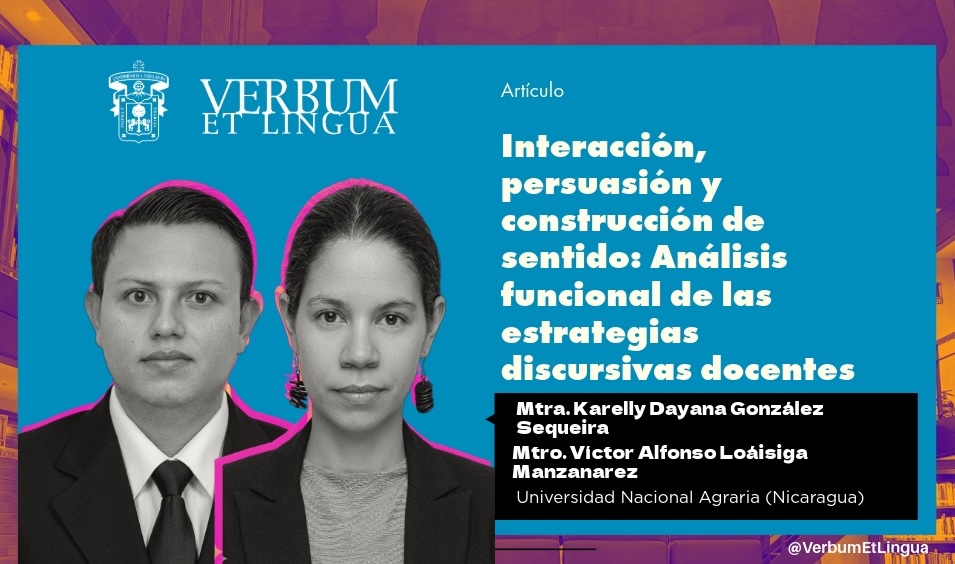
Interaction, persuasion, and meaning construction: Functional analysis of teachers' discursive strategies
DOI:
https://doi.org/10.32870/vel.vi27.371Keywords:
Learning, discourse, teacher, teacher’s discursive strategy, communicative interactionAbstract
Teacher discourse, an essential component of pedagogical practice, significantly influences students' cognitive, socioemotional, and communicative development, as well as the establishment of a conducive learning environment. For this reason, this article examines the discourse strategies employed by university professors to identify them in the educational context. To this end, a qualitative case study was conducted to observe the verbal interactions in the classroom between two professors of Spanish Grammar I and II. Additionally, the ESTDI questionnaire was used as an instrument to facilitate discourse categorization. The results revealed 18 strategies used; among the most frequent were I.R.E. (Interrogation, Response, Evaluation), persuasion, argumentative intention, and contribution re-elaboration. It is concluded that although educators used similar resources, the frequency and personal characteristics of these resources determine classroom interaction.
Downloads
Downloads
Published
Versions
- 2021-01-15 (2)
- 2026-01-30 (1)
How to Cite
Issue
Section
License
Copyright (c) 2026 Karelly Dayana González Sequeira and Víctor Alfonso Loáisiga Manzanarez

This work is licensed under a Creative Commons Attribution-NonCommercial 4.0 International License.
Authors retain full copyright (both moral and economic rights) over their works without restrictions. Upon submitting their article, authors grant Verbum et Lingua (and the University of Guadalajara) the right of first publication.
All articles published in Verbum et Lingua are distributed under the Creative Commons Attribution-NonCommercial 4.0 International (CC BY-NC 4.0) license. This allows third parties to read, download, copy, and redistribute the material in any medium or format, and even adapt it, provided that appropriate credit is given to the original author and the journal, and the material is not used for commercial purposes.