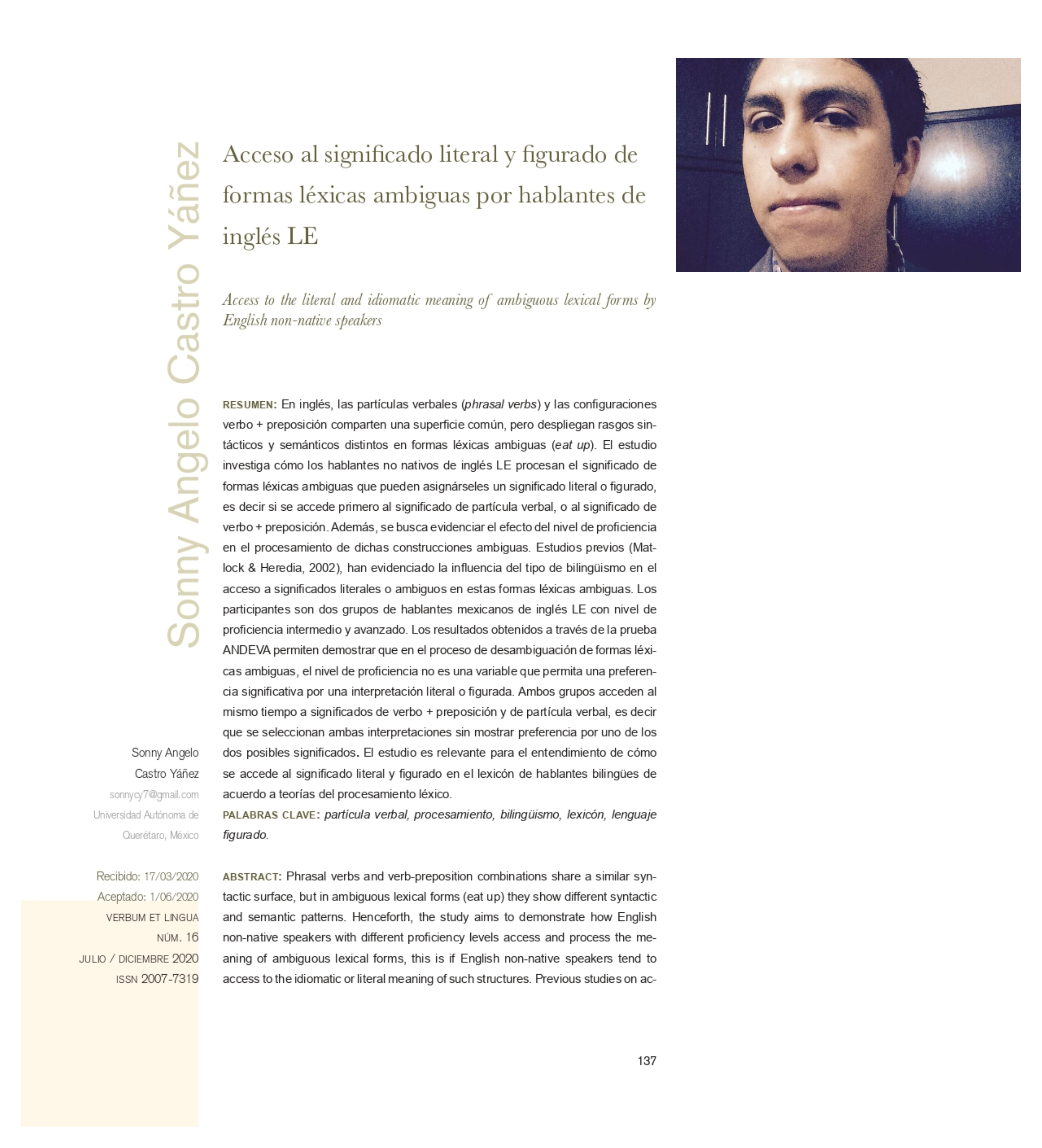
Acceso al significado literal y figurado de formas léxicas ambiguas por hablantes de inglés LE
DOI:
https://doi.org/10.32870/vel.vi16.155Schlagworte:
Partícula verbal, Procesamiento, Bilingüismo, Lexicón, Lenguaje figuradoAbstract
En inglés, las partículas verbales (phrasal verbs) y las configuraciones verbo + preposición comparten una superficie común, pero despliegan rasgos sintácticos y semánticos distintos en formas léxicas ambiguas (eat up). El estudio cómo los hablantes no nativos de inglés LE procesan el significado de formas léxicas ambiguas que pueden asignárseles un significado literal o figurado, es decir si se accede primero al significado de partícula verbal, o al significado de verbo + preposición. Además, se busca evidenciar el efecto del nivel de proficiencia en el procesamiento de dichas construcciones ambiguas. Estudios previos (Matlock & Heredia, 2002), han demostrado evidencia de la influencia en el tipo de bilingüismo en el acceso a significados literales o ambiguos en formas léxicas ambiguas. Los participantes son dos grupos de hablantes mexicanos de inglés LE con nivel de proficiencia avanzado e intermedio. Los resultados obtenidos a través de la prueba ANDEVA permiten demostrar que en el proceso de desambiguación de formas léxicas ambiguas, el nivel de proficiencia no es una variable que permita una preferencia significativa por una interpretación literal o figurada. Ambos grupos acceden al mismo tiempo a significados de verbo + preposición y de partícula verbal, es decir se seleccionan ambas interpretaciones sin mostrar preferencia por uno de los significados. El estudio es relevante para el entendimiento de cómo se accede al significado literal y figurado en el lexicón de hablantes bilingües de acuerdo a teorías del procesamiento léxico.
Downloads
Downloads
Veröffentlicht
Zitationsvorschlag
Ausgabe
Rubrik
Lizenz
Los autores conservan los derechos de autor completos (tanto morales como patrimoniales) sobre sus obras sin restricciones. Al enviar su artículo, los autores otorgan a Verbum et Lingua (y a la Universidad de Guadalajara) el derecho de primera publicación.
Todos los artículos publicados en Verbum et Lingua se distribuyen bajo la licencia de Creative Commons Atribución-NoComercial 4.0 Internacional (CC BY-NC 4.0). Esto permite a terceros leer, descargar, copiar y redistribuir el material en cualquier medio o formato, e incluso adaptarlo, siempre y cuando se dé el crédito adecuado al autor original y a la revista, y el material no se utilice con fines comerciales.